Boston Stories
Murder at the Homeless Civil Rights Project

We met at a hole in the wall bar about a half mile east of the Boston Common, midway between the “combat zone” and the financial district. I was on my second beer with Boston Foundation program officer Ruth McCambridge, delivering a soft funding pitch over french fries and cigarettes.
By spring of 1991, more than a decade had passed since enlisting in the US Air Force. I’d done my four years and gone on to college. At UMass-Amherst, I found myself as a student radical and started my first newspaper, an anarchist collectively-produced monthly called critical times.
The college years were well spent. I’d languished for three days in DC Central Cellblock, getting arrested for Mitch Snyder of Washington DC’s Community for Creative Non-Violence and graduated in 1987 with a degree in social theory and a journalism minor.
The ensuing unemployability led to several scrappy years of alternative press work, pulling overnights at First Church Congregational Shelter in Cambridge, and dabbling in homeless organizing. At twenty-nine, I became Director of Boston Jobs with Peace, a single-staff organization with a budget of maybe eighty grand on a good year.
The JwP national office was at 76 Summer Street, three blocks east of where the Green and Orange lines converge at Park Street Station. Our itty-bitty local chapter attached itself to their relatively robust resources.
Boston JwP had a ten-by-twelve foot office with its own door just off the conference room. We had full access to the national’s computers and copier.
About a dozen local affiliates from places like LA, Oakland, Baltimore, and Detroit either organized homeless people or public housing tenants. We were united in our strident demands to cut military spending and tax the rich.
It was an open secret that Jobs with Peace was a front group for the Chicago-based Communist Labor Party. CLP theoretician Bruce Parry frequently came to the national conferences to auger the dystopian automated future and praise the lumpen-proletariat as the revolutionary vanguard.
The Berlin Wall fell in November of 1989, and the much anticipated “peace dividend” dismally failed to materialize. The foundation funding dried up alongside the dream. Within a few years, National JwP would fold like a house of cards.
But none of us, just then, were worried about that. My mildly CLP-infiltrated Boston board let me do the homeless empowerment organizer thing as I pleased. So long as I raised the money to pay myself, I had a salary, a title, and no health insurance.
The first year or two was a series of attention-getting Homes Not Bombs direct action protests and encampments. Our most notable achievement was organizing thirty-two buses to the 1989 Housing Now! March in Washington, DC.
The Boston contingent joyously led our favorite regionally-flavored call and response chant: “Hey youse guys! … How’s about a house!”
We were making noise and getting in the papers, but I wasn’t sure any of it meant much. This dilemma would eventually lead to Spare Change, my first street paper, but that path had a few more twists to deliver.
Ruth had recently given me a xerox of Peter Marcuse’s Neutralizing Homelessness. His landmark analysis, that government distracts with division and data and funds homeless services precisely to the extent required to not be perceived as immoral, changed the way I saw.
The 80’s was a decade where the numbers of emergency shelter beds more than quadrupled in most cities. The New York Times talked about “compassion fatigue,” and places like the Tremont Ave Burger King and Cambridge Au Bon Pain no longer served homeless people.
People sleeping in the Boston Common were getting beat up and run off by the cops. This, to us anyway, was new, and that was our front yard. Our little group — made up mostly of homeless folks and radicalized line-staff from nearby Pine Street Inn — responded by organizing the Homeless Civil Rights Project.
A group of volunteer lawyers and MIT students gathered affidavits to help document discrimination and abuse. We prepared to go public, but first I had a problem to solve.
The Union of the Homeless had recently been launched by Chris Sprowal, and Savina Martin led the Boston Chapter. Homeless identity politics were in their first bloom, asserting slogans like “Nothing about us without us” and “Homeless, not helpless.”
“We’re not homeless,” others, usually not homeless, would say. “We’re houseless.” This shit would annoy me for the next thirty years.
My friend Ruth was a savvy working-class organizer from Dorchester that the Boston Foundation had somehow hired to give away their money. I wanted some, but I also wanted advice.
I saw my role as organizer, coach, and facilitator. Not a spokesperson. “When we take this to the press, I don’t want to be the guy doing the talking,” I said, sparking up my third Marlboro Light of the hour. “We need an organizer to run this thing who’s from the streets.”
Ruth lit her own and took a long pause. “I might have someone.”
“Yeah?”
“He’s homeless. Has a prison rights organizing background. Brilliant guy. Taught himself German to read Goethe in the original. Jailhouse lawyer. Just out of prison.”
“What for?”
“Bank robbery.”
“Cool.”
Ruth wrote a name and number on the inside of a matchbook and slid it across the table. “Jack McCambridge.”
“If this goes sideways, I don’t want to hear about it.”
I crushed out the smoke and picked up the matches while Ruth took the check.
A Brief and Furious Romance
Jack was all that Ruth advertised and more. For example, he was her ex-husband. He stole his first car at seventeen and had a series of early criminal encounters. Jack first shot a man in 1964 during an argument in a Roxbury bar. That was his first manslaughter conviction.
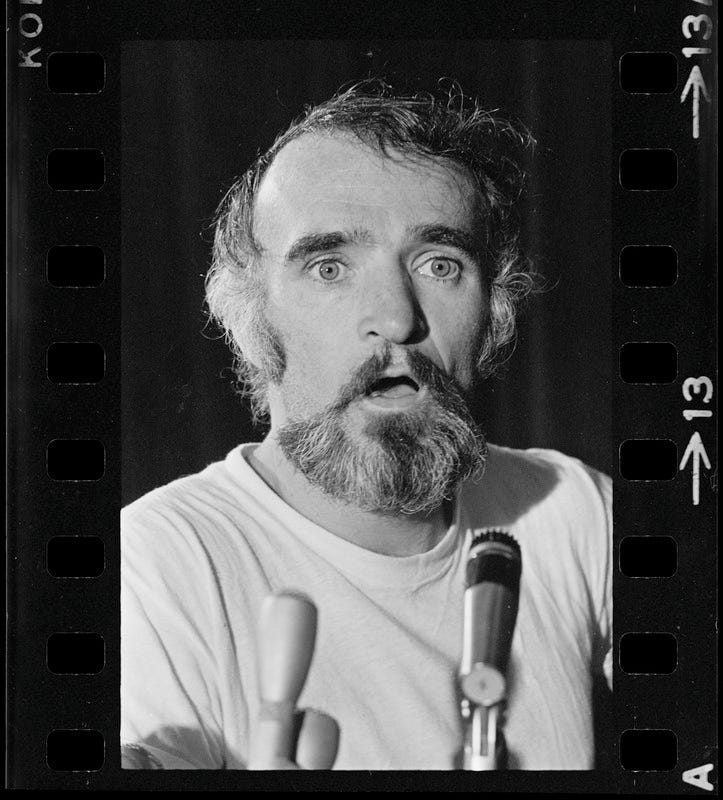
He was a leader in early-70s prison organizing, and that’s when baby radical Ruth first encountered him and fell in love. The photo up top is Jack, speaking at Walpole in 1972.
The marriage soured after Jack was released and tried his hand at bank robbery. Apparently, he wasn’t good at it. Not good enough, anyway.
That bought Jack another long bid. He was one of those guys that thrived inside the walls. The sobriety and structure suited him. Sadly, freedom would soon make short work of that.
Jack was almost twice my age, not tall, and had a boxer’s face without much hair. He wore white Converse sneakers and spoke like a guy from Southie. While in shape from riding his ten-speed everywhere he went, he had a compact potbelly that his knit shirts did nothing to hide.
He related to homeless folks as naturally as water running through a stream-bed, was great with a press quote, and looked the damn role. Even better, we were winning.
Briefly, I had just what I was looking for.
We got a bad actor nicknamed Robocop transferred from motorcycle to desk work. Au Bon Pain agreed to a set of demands, and we held a press conference in Harvard Square to announce the success.
Jack took the affidavits we’d collected and copied the two-inch pile into a six-inch pile. He waved these over his head from the podium like Joe McCarthy announcing communism within the flag officers. Everyone bought it. We were getting press. I loved it.
The Boston Foundation gave us $10,000. The HCRP was getting somewhere.
The honeymoon lasted maybe two months. Jack’s attention grew scattered and his temper short.
He moved his desk from facing the wall 90 degrees to my own to the center of the room, where he sat facing my back. Construction noises bled in from Summer Street. It was late-morning. Jack’s face was in his hands. The sound of jackhammers seemed to cause him physical pain.
That was the moment I knew what I’d suspected. Sobriety had fled the scene, and Jack, as an active alcoholic, was a bit of an asshole.
I wasn’t much of a supervisor and was unlettered in the ways of HR. Other conflicts were developing. He named Dick Doyle — a lovably avuncular, late-fiftyish ex-con buddy from South Boston — as his co-director.
Neither of them especially liked most of the other emerging homeless leaders that gathered around our conference room table. This was the mostly black-led crew that was raring to start a street paper.
Jack suspected one of the leaders in particular was a sociopath. While he wasn’t wrong, tensions in the overall organizing project had acquired a racially-tinted tone.
Things deteriorated, and eventually, I needed to choose. When Jack showed up, drunk and insulting, to hold court at the head of the table at a Boston Coalition for the Homeless meeting, I was mortified. I pulled the plug.
The firing was messy, due in large part to my own inexperience. Jack ran to Ruth and she was pissed. Ruth tried to claw back the grant to redirect to Jack and Dick.
A delegation that included Board President MIT professor emeritus Lisa Peattie met with Boston Foundation head Anna Faith Jones. They said, “We could describe the conflicts here, if you need that?” She did not.
Another board member, an elderly Boston lawyer who once advised me to “always conduct yourself is if the people you represent are in the room,” asked how we “let ourselves get in the briar patch” with someone like Jack?
We decided to exit said briar patch by letting the HCRP go to Dick and Jack, but we were keeping the $10k. I would not see Ruth again for more than a year.
The last time I spoke to Jack was when he called me at home. “If you tell anyone I said this, I’ll deny it,” he opened.
Jack had called to say I was a good guy, but not nearly tough enough for the work. He wanted me to know that.
“I knew that about you the moment I saw that fortune taped to your phone.”
There was, in fact, a fortune on my phone. There were lots of Chinese places near JwP, and one cookie had spoken to me in particular. I can still visualize the slender strip of paper taped to the front of my tan, now vintage, push button phone:
“He who expects no gratitude shall never be disappointed.”
The Return of Jack McCambridge
On November 12, 1993, around 8 pm, my phone rang. It was Jim Stewart, the minister that ran First Church Shelter. He and Dorchester Minister Stuart Guernsey had been Mitch Snyder’s regional northeast lieutenants, and Jim was the closest thing I had to a mentor.
“Turn on the TV,” he said. “The Bread and Jams van rolled on the interstate and Dick is dead. It looks like Jack killed him.”
“Holy shit.”
“Well, you’ll need to come up with something better than that. I just got off the phone with The Globe and they’re calling you next.”
I turned on the TV. Just like it happens in the movies, the story was on.
A white cargo van was spotted by police swerving and driving too slowly on the Southeast Expressway near Dorchester. They hit their blues and the van picked up speed, careened into the meridian, and fishtailed across the expressway to crash and roll.
Dick was thrown from the van and crushed under a wheel. Jack was pinned in the driver’s seat and was extracted unconscious through the front windshield.
A double-barreled derringer pistol fell out of his jacket pocket and was handed by an EMT to a State Trooper. Dick, they soon observed, had been shot in the right side of the face. He was dead before the crash with a .22 blood alcohol level.
Jack was a well-known Boston homeless advocate. Now, he was a homicide suspect.
Dick was later found to have a second wound. He’d been shot in the back from about three feet away. A .9 millimeter with a full clip was also found in the van, along with a Billy club that matched a crease in Dick’s head.
Jack and Dick had continued as co-directors of the HCRP and had organized a homeless people’s walk from Boston to Kennebunkport. I remember that protest at the Bush’s, but not Jack and Dick being there.
A few days before the crash, Jack had turned up in a blind drunk where Dick worked at Bread & Jams, threatening both Dick and the van with a baseball bat.
Now, this. Dick was a beloved figure. The community was rocked. Jack was charged a second time with manslaughter.
Jack, being Jack, fired his court-appointed lawyer to represent himself pro se. His defense was that Dick was giving Jack a ride home, but detoured to sell a gun: the derringer he’d lain on the dashboard.
Jack objected, and things escalated after he called Dick a child molester. Dick pulled the .9 mm and Jack grabbed the Derringer. It was self-defense.
If Jack was going back to prison, it would not be as the guy who shot a homeless advocate colleague. It would be as the guy that blew away the child molester.
Jack understood the power of narrative.
The jury didn’t buy it, and Jack went back in for eleven years. He got out in 2006, at sixty-eight. I know because a story showed up in the Boston Globe.
Jack was being represented by the ACLU. He was mad that he was denied a bicycle courier license. I heard rumors that he also showed up at Spare Change around then, looking for a job.
The last time I saw Ruth was at Dick’s funeral. She was seated near the aisle in the back of the church and I caught her eye as I was leaving.
As I approached to say I know not what — something appropriate and anodyne perhaps — her face collapsed into grief and she waved me away.
Maybe there was nothing to be said.
Thrilled to more of your writing!
Say more about why the “we’re not homeless, we’re house less” pisses you off. If this same anger is the through line - and maybe it’s just the initial motivation but not the true heart? - as a reader we want to know more here.
You very much have a book growing. The pacing for an article is a nice clip and you’ve set some vivid scenes. I see places where, with a bigger canvas, you could give texture to the other characters - including to yourself - in the story. Like, how did you feel getting this job after mostly unemployment? How did your relationships change with and without formal organizational roles?
Boston was more interesting in the 80’s then I thought growing up in Brookline!